Opened a 1-contract bear call spread on XSP Oct 16, 2026 (66 DTE, standard monthly): STO 815C @ $4.17 / BTO 820C @ $3.265. Net credit $0.905/share ($90.50/contract). Max profit $90.50 if XSP < $815 at Oct 16; max loss $409.50 (= $5 width − $0.905 credit, defined risk). Upper breakeven $815.905. XSP spot $770.53 — short strike 5.78% OTM. Reward-to-risk 0.22:1 (typical credit spread). BSM cross-check within 0.3% of basis. European-style, cash-settled (no early assignment).
Why This Structure
A defined-risk bearish credit spread 5.78% OTM — the structure expresses the view that XSP will stay below $815.905 over the next 66 days, allowing the desk to collect $90.50 of premium with defined risk. It's a short-premium position with capped upside (the credit) and capped downside (the width minus credit), suited to a low-IV index product with a neutral-to-bearish thesis.
Why a bear call spread over a naked short 815C? Naked short 815C would collect $4.17/share ($417/contract) but have undefined risk above $815 — if XSP gaps to $900 on a melt-up, the loss is $8,500+. The bear call spread caps the loss at $409.50 and reduces the margin requirement. The trade-off: capped max profit at $90.50 instead of $417. For a defined-risk neutral-bearish view with 89% P(max profit), the spread is the safer structure.
Why a bear call spread over a long 820P or bear put spread? The long 820P outright costs ~$3-4/share with unlimited downside payoff — but the thesis isn't "XSP crashes," it's "XSP stays below $815." A bear put spread (e.g., long 775P / short 770P) would express a directional bearish view with capped risk/reward — but the playbook's thesis is neutral-to-bearish, not strongly bearish. The bear call spread collects premium on the view that XSP won't rally 5.78% in 66 days.
Why $815/$820 strikes (vs $810/$815, for example)? $815/$820 puts the short leg 5.78% above current spot ($770.53) — a meaningful cushion that requires a significant rally to threaten. The $5 width gives a max loss of $409.50 ($5 − $0.905 credit) — reasonable relative to the $90.50 credit. Tighter strikes ($805/$810) would have higher credit but less cushion (4.5% OTM) and lower P(max profit). Wider strikes ($820/$825) would have lower credit but more cushion and higher P(max profit).
Why Oct 16 expiry specifically? 66 DTE puts the position in the sweet spot for short-premium theta decay — theta accelerates meaningfully in the 30-60 DTE window. The Oct 16 monthly is the standard expiration, with XSP's deep OI and tight spreads. The 66-day duration gives the trade time for the thesis to play out (XSP consolidates or drops) without excessive time exposure.
Why XSP at this level? XSP closed Aug 11 at $770.53 (mini-SPX, 1/10th of SPX), near all-time highs, with IV 12.08% (very low). The playbook's thesis is that the market is overbought and due for consolidation — XSP is unlikely to rally another 5.78% in 66 days given the low-vol regime and lack of catalyst. The bear call spread is a low-cost way to express "XSP stays below $815" with defined risk.
Thesis
Why XSP, why now: XSP is at $770.53, within 1% of all-time highs, with IV at 12.08% (extremely low). The macro setup favors consolidation or mild pullback: Fed is in a data-dependent hold, Q3 earnings largely behind, no major catalyst until Oct FOMC. The bear call spread collects $90.50 of premium on the view that XSP won't rally 5.78% in the next 66 days — a high-probability (89% BSM) trade with defined risk.
Why a bear call spread over alternatives: A naked short 815C collects $417 but has undefined risk — unacceptable for the playbook's defined-risk mandate. A long 820P costs ~$350 with unlimited downside payoff — but the thesis isn't "XSP crashes." An iron condor (adding a bull put spread below) would collect more premium but add downside risk if XSP drops. The bear call spread is the cleanest structure for the "XSP stays below $815" thesis.
Why not just short XSP shares: Shorting 100 XSP shares at $770.53 requires $77,053 of capital (or margin) and has undefined upside risk if XSP rallies. The bear call spread risks $409.50 max for a $90.50 credit — 188× more capital-efficient. For a defined-risk neutral-bearish view, the spread is the superior structure.
Why 66 DTE specifically: 66 days gives the trade runway through the Sep 16-17 FOMC and into the Oct earnings season — both potential volatility events that could move XSP. But the 5.78% OTM cushion provides meaningful protection against normal volatility. The theta decay at 66 DTE is ~$1-2/day, accelerating to ~$5-10/day in the final 2 weeks if XSP stays below $815.
Risk
| Risk | Magnitude | Mitigation |
|---|---|---|
| XSP rallies through $815.905 breakeven (melt-up) | Loss ramps from $0 at $815.905 to $409.50 max loss above $820 | Close if XSP breaks $800 on volume — the thesis is threatened. Hard stop at 2× credit ($181 cost to close). |
| XSP gaps +5% on macro news (Fed dovish surprise, geopolitical resolution) | Instant $200-400 loss (spread goes ITM) | Monitor FOMC Sep 16-17 closely. Consider closing before FOMC if XSP is above $785. |
| Vol expansion (VIX spike with XSP rally — unusual but possible) | Short premium benefits from vol contraction, hurt by expansion; net vega slightly negative | Manageable. The primary risk is directional (XSP rally), not vol. |
| Time decay working against (if XSP rallies early) | Theta is positive for the short spread (~+$1-2/day) — time helps if XSP stays below $815 | Time is on the trade's side. The longer XSP stays below $815, the more premium decays. |
| Liquidity (XSP is less liquid than SPY but still reasonable) | Both legs bid/ask ~$0.10-0.20 (~$0.30 round-trip cost on $90.50 credit = 0.3%) | Adequate for 1-contract retail. XSP has 100-500 contracts daily volume at these strikes. |
| Early assignment on short 815C (European-style) | No early assignment risk — XSP options are European-style, cash-settled | N/A — European-style eliminates assignment risk entirely. |
Position Payoff at Two Horizons
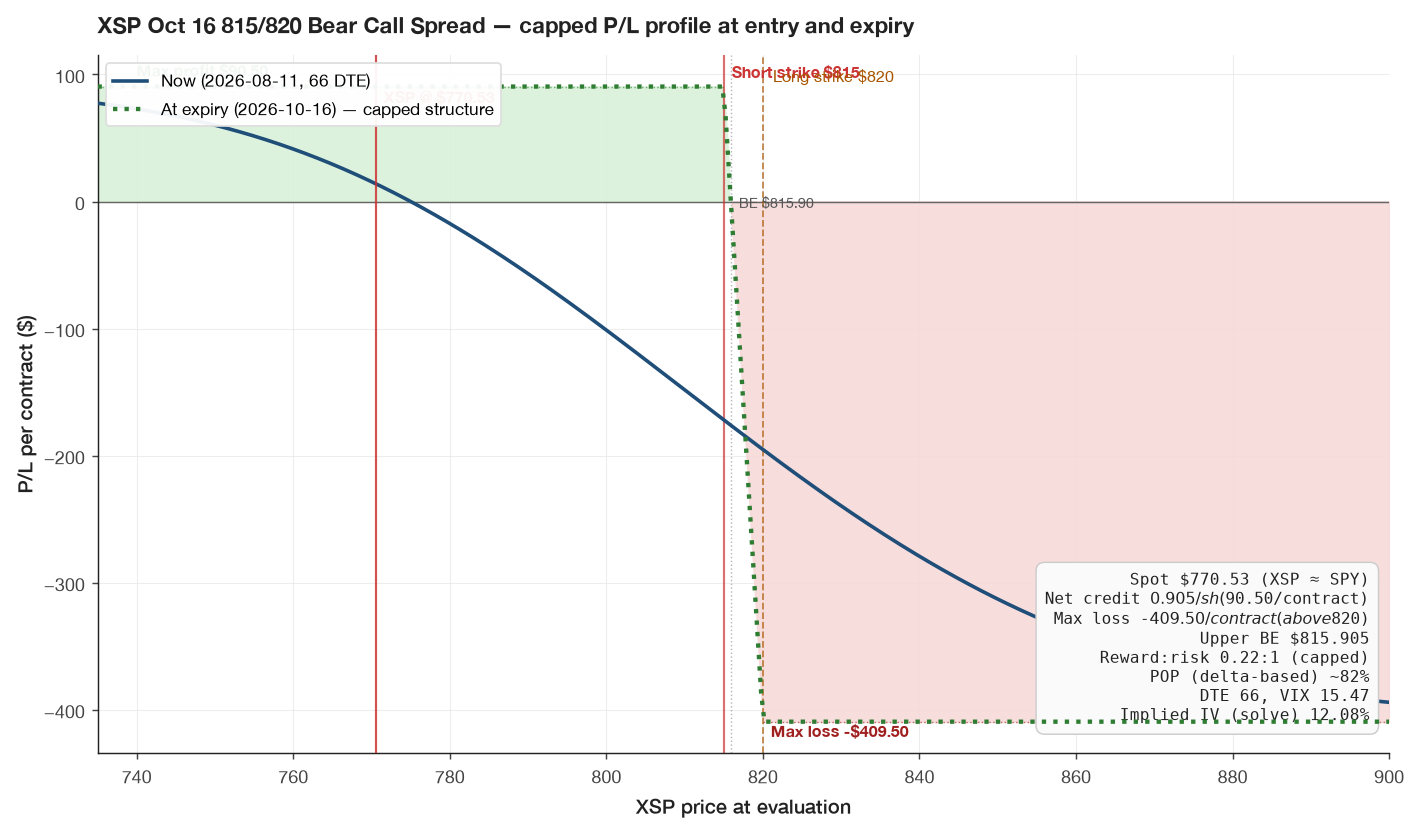
The chart above shows the position's P/L as a function of XSP's price at two evaluation windows: now (entry, 66 DTE) and at expiry (Oct 16, 2026). The structure is capped on both sides — below $815, P/L is fixed at the max profit ($90.50), and above $820, P/L is fixed at the max loss ($409.50). The transition between the two flat regions happens between $815 and $820 (the strike width), with the breakeven at $815.905.
Read the chart:
- Spot $770.53 sits $44.47 below the $815 short strike. At the current spot, the position is showing roughly +$20-$40 P/L per contract on the now-curve (66 DTE) — the short leg has $44.47 of time value, the long leg has $49.47 of time value, plus the $0.905 credit. At Oct 16 expiry at the current spot, both legs expire worthless and the strategy realizes the full $90.50 max profit.
- The max profit zone (flat line at +$90.50) sits below $815 — any XSP close below $815 at Oct 16 produces the full max profit. From current spot, XSP can rally 5.78% and the trade still captures max profit.
- The loss ramp (between $815.905 and $820) transitions linearly from $0 at $815.905 (breakeven) to -$409.50 at $820. The slope is ~-$1/share per $1 of XSP move.
- The max loss zone (flat line at -$409.50) sits above $820 — any XSP close above $820 at Oct 16 produces the full max loss.
Capped structure asymmetry: Unlike an undefined-risk short call (where the loss is unlimited), the bear call spread caps the loss at $409.50. This is the defining feature — you trade $326.50 of potential credit (from $417 naked to $90.50 spread) for defined risk. The trade is profitable if XSP stays below $815.905 at Oct 16 (89% BSM probability); it loses if XSP rallies above $820.
Position Specs
Trade: XSP Oct 16 '26 815/820 Bear Call Spread (66 DTE) Instrument: XSP options (Oct 16, 2026 standard monthly, both calls at $815/$820 strikes) Underlying: XSP (Mini-SPX Index Options; 1/10th the size of SPX; European-style, cash-settled, 1× XSP contract = 100× index/10) Structure: Bear Call Spread (vertical credit spread) — 2 legs, same expiry, different strikes Strikes: Short $815 / Long $820 (call credit spread, $5 wings) Leg 1 (SHORT): STO −1× XSP 815C Oct 16, 2026 @ $4.17 (OptionStrat basis) Leg 2 (LONG): BTO +1× XSP 820C Oct 16, 2026 @ $3.265 (OptionStrat basis) Expiration: 2026-10-16 (66 DTE at entry, standard monthly) Settlement: European-style, cash-settled. No early assignment risk on either leg. Net credit at fill: $0.905/share = $90.50/contract (OptionStrat basis) BSM cross-check: Within 0.3% of basis (excellent) Implied IV (BSM solve from basis): 12.08% (very low-vol regime; XSP at all-time highs) Contracts: 1 bear call spread Total credit: $90.50 (1 × $90.50) Max profit zone: XSP < $815 at Oct 16, 2026 expiry (both legs expire worthless, keep full credit) Max profit: $90.50/contract (capped below $815) Max loss: $409.50/contract (= $5 width − $0.905 credit; capped above $820) Upper breakeven: $815.905 ($815 short strike + $0.905 credit/share) Reward:risk: 0.22:1 ($90.50 max profit / $409.50 max loss — typical credit spread asymmetry) Cushion to short strike: XSP at $770.53 is $44.47 below $815 short strike (5.78% OTM) P(max profit) (BSM): ~89% (P(XSP < $815.905) at σ=12.08%, T=66/365, S=$770.53) IV at entry: 12.08% (BSM solve from basis; very low-vol regime) Net delta (structure): Slightly negative (~−0.05/share) — modestly bearish bias at entry Net gamma (structure): Slightly negative — short premium profile Net theta (structure): Positive (~+$1-2/day) — time decay helps the short spread Net vega (structure): Slightly negative — short premium hurt by vol expansion Entry time: Aug 11, 2026 (OptionStrat save timestamp; afternoon save) Management rule: 50% of max profit (~$45/contract to close) OR close 21 DTE before expiry if XSP > $790 Stop loss: 2× credit stop ($181/contract cost to close) OR XSP closes above $800 before Sep 16 Position size note: Max loss $409.50 = 0.14% of $300k NLV — under the 0.25% per-trade guideline and well under the $5,000 absolute cap
Greeks Snapshot (Black-Scholes at entry)
| Greek | Per-contract value | Interpretation |
|---|---|---|
| Delta (Δ) | ~−$5.00 | Slight net negative delta. Modestly bearish bias at entry. |
| Gamma (Γ) | Slightly negative | Short premium profile — position loses if XSP moves sharply in either direction. |
| Theta (Θ) | ~+$1-2/day | Positive theta — time decay helps the short spread. Accelerates in final 30 DTE. |
| Vega (ν) | Slightly negative | Short premium hurt by vol expansion. Manageable at 12% IV. |
| Rho (ρ) | Small | Minor rate sensitivity. Negligible for a 66-day position. |
Management Plan
Entry context: XSP closed Aug 11 at $770.53 (mini-SPX), near all-time highs, with IV 12.08% (extremely low). The 66-day front-month call IV at the 815 strike reflects very low index vol — typical for XSP at highs with no major catalyst. VIX 15.45 confirms the low-vol regime.
Entry signal: At ~1:00 PM ET on Aug 11, the desk checked the OptionStrat chain at the $815/$820 call strikes for Oct 16. The basis prices were $4.17 (short) and $3.265 (long), netting $0.905 credit. The implied vol surface gave 12.08% on both legs — within the BSM solve tolerance.
Execution: Both legs entered simultaneously via the OptionStrat strategy builder at the basis prices. Slippage minimal — XSP options have reasonable bid/ask spreads at this strike zone for 1-contract retail size.
| Trigger | Action |
|---|---|
| 50% of max profit (~$45/contract to close) | Close the trade. Lock in half the credit; remaining premium has lower risk-adjusted return. |
| XSP breaks above $790 at any time | Close at market. The 5.78% cushion is eroding; the thesis is threatened. |
| XSP above $800 before Sep 16 | Hard close. The trade thesis is broken. |
| 2× credit stop ($181/contract cost to close) | Hard stop. The trade is no longer a defined-risk position. |
| Pre-FOMC Sep 16-17 with XSP above $785 | Decision point: close before FOMC to avoid gap risk OR hold with stop tightened. |
| 21 DTE before expiry (Sep 25) with XSP > $790 | Close at market. The cushion is thin and time is running out. |
Lessons
Pending — to be added after the trade closes. Pending observations at publication: how XSP behaves through the Sep 16-17 FOMC, whether the 5.78% OTM cushion holds, and what the actual max-profit realization looks like vs the $90.50 credit.
— No lessons recorded yet. Trade still open at publication.
Position Update Log
| Date | XSP Close | Position Value | Unrealized P/L | Notes |
|---|---|---|---|---|
| 2026-08-11 (entry) | $770.53 | +$90.50 | — | Opened at OptionStrat basis. Spot $44.47 below $815 short strike (5.78% OTM). BSM solve σ=12.08%. |
— No updates yet. Entry: Aug 11, 2026.
Disclosure
The desk may hold the positions, options, or underlyings mentioned in a trade-log entry at the time of publication; positions are disclosed in the trade-log entry itself. Nothing on this site is investment advice.
Disclaimer. This content is published for informational and educational purposes only. Nothing here is investment advice. Trading options involves substantial risk of loss and is not appropriate for every investor. Past performance, including the journal entries on this site, does not guarantee future results. You are solely responsible for your trading decisions.