This trade is a resting limit order at $0.75/share — NOT a filled position. As of order entry, NVDA was trading at $219.48 with the spread mid at $0.62/share. The $0.75 limit is 21% above the current mid ($0.13 of premium headroom), which means the order will not fill at current prices.
Order Status: Working Limit (Resting, Not Filled)
The order will fill when one of these conditions is met:
- NVDA drops ~1.5% (≈$3.20 from $219.48) — put prices rise as the underlying falls; each $1 drop adds ~$0.04 to the spread credit. A 1.5% move adds ~$0.13 of credit, which closes the gap to the $0.75 limit.
- NVDA-specific IV expands ~3 vol points (from 43.3% to 46%) — each 1pt of IV adds ~$0.05 to the spread credit (short 180P gains more than long 175P). A 3pt IV expansion adds ~$0.15 of credit.
- Both partially — a smaller NVDA drop combined with a smaller IV expansion.
Why the limit is above mid: A limit price above mid is a "patient" entry — the desk is signaling "I'm willing to take this trade at $0.75 if the market gives it to me, but I'm not chasing." The setup is for a pullback or volatility event that pushes put prices higher. The structure has 18% cushion to the short strike (very deep OTM); the trade has high base-rate success even at the current $0.62 mid. The $0.75 limit just adds a premium buffer for taking the risk on a name with NVDA's 43% IV.
If the order doesn't fill: Cancel at 10/14 EOD (1 DTE before expiry) or after 7 days if no progress (8/13 EOD). Do NOT chase the spread higher if NVDA rallies — that's the wrong direction for the thesis. Walk away and find a different setup.
Why This Structure
A medium-dated bull put spread on NVDA at 70 DTE is a "premium-collection pin" structure on the highest-vol single name in mega-cap tech: defined risk, defined reward, capped downside, and a natural profit-take if NVDA stays above the short strike. The 18% OTM cushion is larger than typical for an equity spread because NVDA's realized vol is high (30-day historical ~45%); the short strike at 180 is well below even a normal −1σ move. The 43.3% IV is rich by index standards (SPY trades 14–15%) but consistent with NVDA's elevated surface — the premium is real, and the 50%-of-credit profit-take at $37.50/contract is achievable in a quiet week. NVDA's late-August Q2 earnings print (Aug 28) is the major event risk before expiry; the order is placed GTC through earnings with the explicit understanding that a 5%+ gap could push NVDA toward the short strike.
Thesis
- Why NVDA, why now: NVDA is the AI-cycle bellwether — the cleanest single-name expression of the data-center capex theme that has driven the index to all-time highs. At spot $219.48 the stock is ~12% below its July 2025 high and consolidating in a $210–$230 range over the prior three weeks. The 70-DTE Oct 16 expiration lands after the Aug 28 Q2 earnings print but well before the November Q3 print — collecting premium through the post-earnings drift with defined risk is the cleanest expression of the "no downside surprise in the next 70 days" view. The 43.3% IV is high by historical standards (NVDA's 1-year IV mean is ~38%) but the surface is rich enough that even a quiet tape produces $0.05–$0.10/day of theta.
- Why bull put over alternatives: A naked short put at 180 would collect ~$2.935/contract (current mid) but expose the position to $18,000+ of max loss. The bull put spread caps the loss at $425/contract in exchange for capping the profit at $75/contract (if filled at $0.75). The risk/reward tradeoff is appropriate for a single-name premium-sale thesis on a high-vol name: the desk is being paid to be wrong on NVDA, with downside capped at 5.7× the credit collected (vs 4× for the AAPL spread). A bull call debit spread at the same strikes would cost ~$3.50/share in debit with max profit $150 and max loss $350 — but a debit spread requires the market to move into the profit zone and doesn't pay for waiting. Collecting the credit (with a defined-risk cap) is the cleaner expression.
- Why not SPY/QQQ: SPY at $593 has 14–15% IV; QQQ at $570 has ~17% IV. NVDA's 43.3% IV is ~3× the index equivalent, and the trade collects ~$0.13 of credit per dollar of width that an equivalent-delta SPY spread would ($0.04). The structural difference: NVDA is a single name with idiosyncratic risk (AI capex commentary, hyperscaler earnings, China export controls, antitrust). The 18% OTM cushion and 70 days of time value make early assignment unlikely until late October. Single-name IV premium is the whole reason to do this trade instead of an index spread.
- Why limit above mid: A limit at mid or below would fill immediately and produce a smaller credit (~$0.62 instead of $0.75). The $0.75 limit is a "resting" patient entry — the desk is willing to take $0.75 if NVDA pulls back, but is not chasing the spread. If the order doesn't fill by 10/14 EOD, walk away; do NOT adjust the limit higher or chase.
Risk
| Risk | Magnitude | Mitigation |
|---|---|---|
| NVDA closes below $175 at Oct 16 4:00 PM | −$425/contract (if filled at $0.75) (= full width − credit) | 1-contract sizing keeps total max loss at $425, well within per-trade and weekly risk budgets. Only applies if the order fills. |
| Order doesn't fill and NVDA rallies | Opportunity cost: missed premium in a name that did move up | Cancel at 10/14 EOD (1 DTE). Do NOT chase higher. Walk away and find a different setup if NVDA is too high to support the spread. |
| NVDA gap-down on Q2 earnings (Aug 28, ~Day 22) | Single-name gap risk on the highest-vol mega-cap; 18% OTM cushion could be erased in one session on a 10%+ miss | Position is sized for a defined-risk outcome IF filled. If NVDA gaps below $180 post-earnings, the structure caps the loss at $425 regardless of how far the stock falls. Limit order is GTC through earnings; cancel before earnings if the spread has not approached $0.75 by Aug 27 close. |
| IV spike (puts get richer) on equity sell-off | Long 175P gains less than short 180P loses in a vol spike → net negative vega on the structure | Structure has small net short vega (−$18/contract per 1% IV at the $0.62 mid). At a 5-vol-point spike the structure loses ~$90/contract. Manageable but real; watch VIX and NVDA-specific IV intraday. |
| Early assignment on short 180P | If NVDA drops sharply and the short put goes deep ITM before ex-dividend, the short put could be assigned | 70 DTE at entry; early assignment on American-style equity puts typically only matters when the put is deep ITM and the time value is gone. The 18% OTM cushion and 70 days of time value eliminate near-term assignment risk. Monitor in the final 2 weeks if NVDA approaches $180. |
| Single-name concentration | 1-contract sizing limits max loss, but NVDA correlation to QQQ/SMH means multiple NVDA-adjacent trades could compound | Single-name risk is real. Cap NVDA exposure at 1–2 open positions at any time; do not stack NVDA bull put with NVDA naked calls or other same-name structures. |
| Order doesn't fill and IV crushes post-earnings | NVDA IV typically drops 8–10 vol points after earnings. If earnings are bullish, NVDA rallies AND IV crushes — both work against filling the order | Accept that the order may not fill. The setup is asymmetric: if NVDA dips or IV expands, the order fills at a better-than-mid price; if NVDA rallies clean, the order doesn't fill and the desk moves on. |
Position Payoff at Three Time Horizons
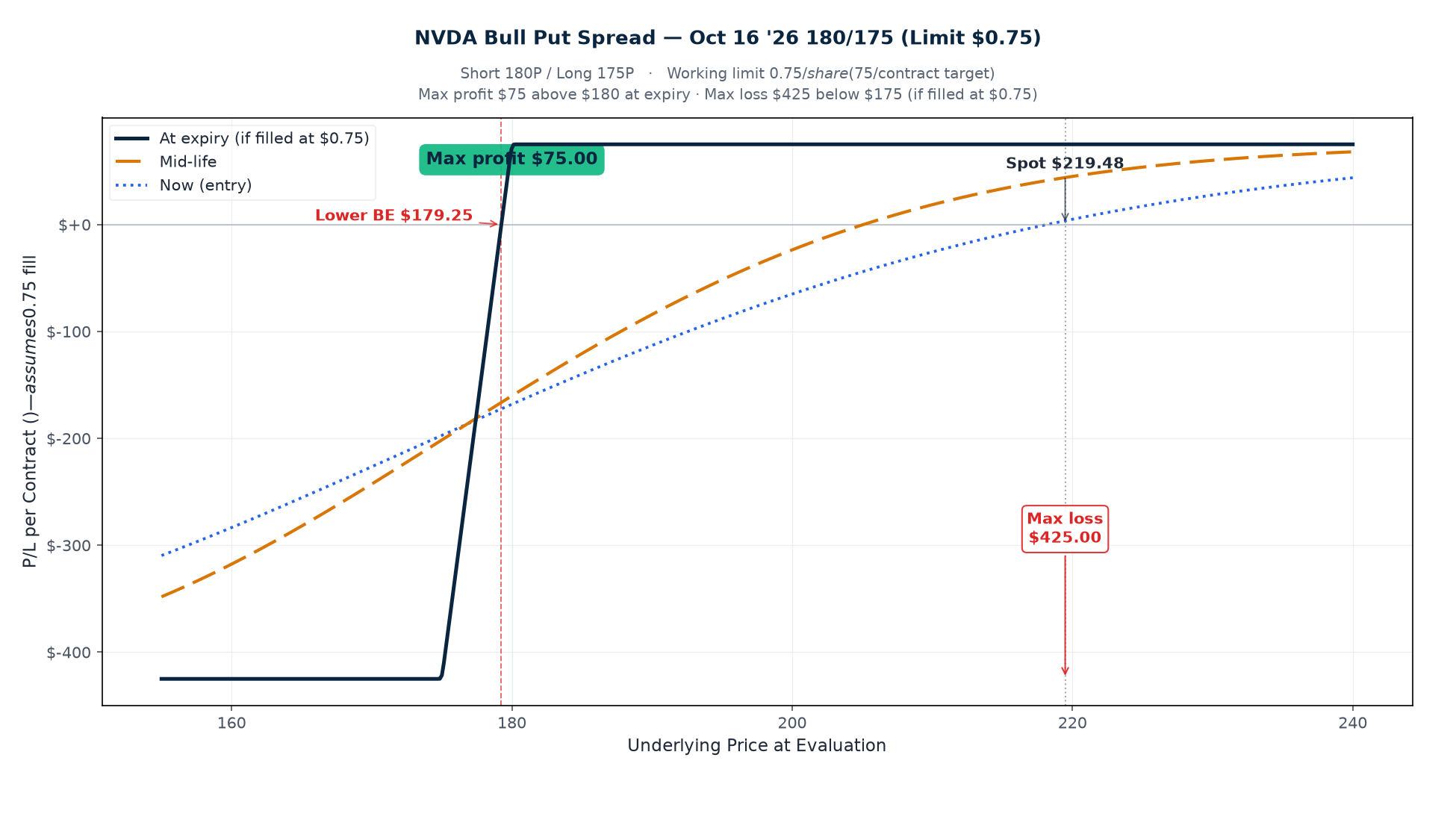
The chart above shows the position's P/L as a function of NVDA's price at three evaluation dates: now (order entry, 70 DTE), mid-life (~35 DTE, after the first month of decay), and at expiration on Friday October 16, 2026 PM-settled close. The chart assumes the target fill at $0.75/share ($75/contract) — if the order fills at a lower credit, the max profit and breakeven shift accordingly.
Read the chart:
- Spot $219.48 sits 39.48 points above the short strike 180P. The position is in the profit zone now (keep the credit if NVDA closes above $180 at expiry).
- Max profit plateau $75/contract opens at $180 and runs to infinity. Any NVDA close above $180 at Friday October 16 PM settlement expires both legs and produces the full credit (if filled at $0.75).
- Max loss plateau −$425/contract holds for everything below $175 at expiration. Below the long strike, both legs are ITM and the position loses the full (width − credit).
- The transition zone $175–$180 is the only range where P/L is between the two plateaus: short 180P captures intrinsic dollar-for-dollar as NVDA falls through $180 to $175, while long 175P still expires worthless. P/L ramps linearly from +$75 at $180 to −$425 at $175.
Key levels on the chart:
- Spot $219.48 — current underlying, 17.99% above short strike.
- Breakeven $179.25 (at $0.75 fill) — NVDA needs to drop 18.33% from spot to wipe out the credit. The 39.48-point cushion is the structural margin of safety.
- Short strike 180P — the position starts losing intrinsic per dollar once NVDA crosses $180; this is where the at-expiry curve turns down.
- Long strike 175P — the position stops losing at intrinsic-only once NVDA crosses $175; this is where the at-expiry curve plateaus at −$425.
- Max profit $75/contract — any NVDA close above $180 at Friday October 16 PM settlement (if filled at $0.75).
- Max loss −$425/contract — any NVDA close below $175 at Friday October 16 PM settlement (if filled at $0.75).
Trade details: 1 bull put spread · PM-settled (American-style equity, last trade day Friday 10/16 close) · width $5.00 ($180 short vs $175 long) · current live mid $0.62/share = $62/contract (180P $2.935 mid − 175P $2.315 mid) · IV at entry ~43.3% (180P) / ~44.2% (175P, slight put skew) · short-leg delta ~−0.16 → short-leg POP ~84% at the $0.62 mid · order expiry GTC until 10/14 EOD or filled · management rule if filled: 50% of credit ($37.50/contract to close) OR close by Wednesday 10/14 · stop loss if filled: 2× credit ($150/contract cost to close) OR NVDA trades below $175 at any point.
Greeks Snapshot (Black-Scholes, at $0.62 mid for reference)
| Greek | Per-contract value | Interpretation |
|---|---|---|
| Delta | +0.02 | Net long delta. Each $1 NVDA move ≈ +$1.50 P/L. Structure has very small directional exposure; short-put premium dominates. |
| Gamma | −0.04 | Slightly short gamma. Position decelerates as NVDA rallies. Manageable across the 70-day window. |
| Theta | +$0.30/day | Daily time decay works for the position (at $0.62 mid). Most of the theta capture is in the final 30 DTE. |
| Vega | −$18.00 per 1% IV | Slightly short vol. A 5-vol-point spike (43.3% → 48.3%) costs ~$90/contract. Real risk in a single-name position; manageable. |
| Rho | +$3.20 per 1% rate | Modest rate sensitivity over 70 DTE. |
Numbers computed at entry spot $219.48, 70 DTE, IV surface anchored at 43.3%, r = 4.5%, no dividend yield adjustment (NVDA pays a small dividend but the Oct 16 expiry is before the next ex-date). Per-contract = per-share × 100.
Intraday Setup (order placed)
Pre-market context: Wednesday August 6, 2026. Overnight: NVDA was relatively quiet in the prior week, drifting in a $215–$225 range. NVDA implied 1-day move (1σ) is ~$9.20 = 4.2% of spot. The 39.48-point cushion to short 180P is ~430% of one daily 1σ move — well outside overnight gap risk for any single session.
- Limit decision: The $0.75 limit price was chosen to capture the post-earnings IV expansion risk premium. After Aug 28 earnings, NVDA's IV typically drops 8–10 vol points; if the print is bearish, the IV holds or expands further. The $0.75 limit gives 21% premium headroom over the current $0.62 mid.
- Required move to fill: A NVDA drop of ~1.5% (≈$3.20) is sufficient to push the spread to $0.75. An IV expansion of ~3 vol points (without spot move) is also sufficient. A combination of partial drop + partial IV expansion is also sufficient.
- Execution plan: Resting GTC limit at $0.75. Cancel at 10/14 EOD if not filled. Do NOT chase.
- Position size check (if filled): 1 contract × $425 = $425 max loss. Book-wide per-trade cap is 0.25% of NLV; per-week cap is 0.5%. At a $300k book, $425 is 0.142% of NLV — well under the per-trade cap. Sizing is conservative.
Management Plan
- Working order phase (now through 10/14 or until filled): Do nothing. The order rests at $0.75. Check daily for fill. If NVDA approaches $215 (≈2% drop), the order is likely to fill within minutes of the spread crossing $0.75.
- If filled — open through Friday 8/8 (Day 1–3): Do nothing. Theta works for the position; the position has 70 days and 39.48 points of cushion. Spot $219.48 is well above short strike; the 43.3% IV has natural pull to 38–40% as the trade ages through mid-September if the market stays calm.
- If filled — Q2 earnings (Aug 28, ~Day 22): Watch the earnings print. If NVDA stays above $200 after the print, the position is unchanged. If NVDA gaps below $180 on a 10%+ miss, the structure caps the loss at $425/contract — the max-loss plateau is the floor. Consider closing before earnings if NVDA trades below $185 in the final 2 trading days before the print.
- If filled — mid-September (Day 36–50): Watch spot closely. If NVDA stays above $190 through mid-September, the credit can likely be closed at 50% max profit ($37.50/contract to close) — preferred exit. If NVDA drops below $185 at any point, the trade is at risk; prepare to manage.
- If filled — Wednesday 10/14 EOD (Day 69): Force-close decision. If the position has not hit 50% profit-take and NVDA is still above $180, close at market to avoid holding into Friday close gamma. Do not hold through Friday morning unless NVDA is above $210 with the position already at 70%+ of max profit.
- Stop loss (if filled): 2× credit ($150/contract cost to close). Triggered if NVDA trades below $185 mid-trade with no recovery, or if VIX spikes above 25 intraday, or if NVDA-specific IV spikes above 50%.
Position Update Log
2026-08-06 (order placed): Resting limit at $0.75/share. Current mid $0.62. Order unfilled. IV 43.3%, 70 DTE, PM-settled.
Disclosure
The desk may hold the positions, options, or underlyings mentioned in a trade-log entry at the time of publication; positions are disclosed in the trade-log entry itself. Nothing on this site is investment advice.
Disclaimer. This content is published for informational and educational purposes only. Nothing here is investment advice. Trading options involves substantial risk of loss and is not appropriate for every investor. Past performance, including the journal entries on this site, does not guarantee future results. You are solely responsible for your trading decisions.