Opened a DRAM bull call diagonal: long 1× 50C Jan 15, 2027 (back month, lower strike, 184 DTE) and short 1× 70C Dec 18, 2026 (front month, higher strike, 156 DTE) — a 20-point strike spread with a 28-day calendar spread. Net debit $8.375/share ($837.50/contract). Max profit $1,231.44 for any DRAM close above $70 at the Dec 18 short expiration; max loss $837.50 (the debit); lower breakeven $55.45; no upper breakeven — the diagonal has no upper cap, though the slope past $70 is shallower than a naked long call because the short 70C caps the upmove at $70 intrinsic minus the residual long time value at short expiration. Entry July 15, 2026 mid-day, on a −6.56% one-day selloff ($61.23 → $57.21); IV 88%. Sized as a single unit (1 diagonal, 2 legs) within the playbook's 0.25% NLV per-trade cap. Reward/risk 1.47:1.
Why This Structure
A diagonal call spread with long 50C Jan '27 (back month, lower strike, longer-dated) and short 70C Dec 18 (front month, higher strike, shorter-dated) is a theta-forward debit structure that expresses a bullish-but-not-violent view on DRAM with a defined-risk cap. The 20-point strike spread more than offsets the 28-day extra time value on the back month, producing a net debit that's roughly 70% the cost of a naked long 50C LEAP.
The structure is built off three sources of edge:
- Strike spread economics. Long 50C pays $17.425; short 70C collects $9.05. Net debit $8.375. The $20 strike spread contributes ~$8 of intrinsic "lift" to the position (long 50C is $7.21 ITM at $57.21, capturing intrinsic that the short 70C doesn't yet have). The short leg's intrinsic will only activate if DRAM crosses $70.
- Time-value arbitrage. Front-month theta (short 70C at 156 DTE decays at ~$0.044/day) harvests faster than back-month theta (long 50C at 184 DTE decays at ~$0.036/day). Net daily theta = +$0.85/contract/day. Over 100 days, that's ~$85 harvested from time alone — recovering 10% of the debit even if DRAM doesn't move.
- Pullback entry. DRAM sold off to $57.21 today, down 6.56% from yesterday's close. The 50C LEAP at $17.43 is meaningfully cheaper than it would have been at the June $80 peak (~$25+ implied). Buying the long leg into a −28% drawdown gives better convexity.
The 156 DTE short expiration (Dec 18) is the natural management horizon. If DRAM reclaims $70 by then, the short leg expires worthless and the position becomes equivalent to a long 50C LEAP with $1,231 of locked-in profit. If DRAM stays below $70, the short leg is ITM at expiration — net assignment of $70 minus residual long intrinsic, capping the upside but still profitable above $55.45.
Thesis
- Why DRAM, why now: Memory cycle setup. DRAM (memory chips — Micron/SK Hynix/Samsung proxy) is structurally levered to AI-driven memory demand. HBM supply is constrained; the DDR5 transition is mid-cycle; spot prices have firmed off the 2024 lows. Pullback entry: DRAM is −28% from its June peak. The −6.56% one-day selloff looks like a memory-cycle dip-buying opportunity, not a structural break; the HBM3E ramp at Micron and the SK Hynix HBM4 roadmap remain intact. IV surface is rich: at 88% IV, the long 50C LEAP prices in significant forward volatility — but the short 70C also compresses on mean reversion, leaving the debit roughly intact. The position is vol-neutral on net (vega −$1.10/contract).
- Why a diagonal over alternatives: Over a naked long 50C LEAP — saves $9.05 ($905/contract) by selling the 70C front-month against it, a 52% reduction in debit cost, with a defined risk cap. Over a same-expiry 50/70 vertical call spread — the vertical costs ~$5.50 with max profit ~$14.50 at short expiration; the diagonal costs $8.38 but caps at ~$11.62 at short expiration — similar reward/risk, but the diagonal wins if DRAM stays range-bound for months (theta harvest) while the vertical doesn't. Over a same-strike 50C Dec/Jan calendar — more pure theta, but unlimited downside risk past $50; the diagonal's $20 strike spread provides a hard floor on the long-leg intrinsic contribution, making it defined-risk. Over a debit put spread — calls keep the long-leg convexity past $70; a put spread caps out at the short strike.
- Entry mechanics: Two separate legs, filled as limit orders mid-day: long 50C Jan '27 at $17.425, short 70C Dec 18 at $9.05. Net debit $8.375 = $837.50/contract. This trade followed the July 13 DRAM long call condor — same underlying, same memory-cycle thesis, different structure to express a more aggressive bullish view with lower net debit.
Risk
| Risk | Magnitude | Mitigation |
|---|---|---|
| DRAM below $50 + debit at short expiry | Full loss of debit ($837.50) | LEAP long 50C retains value even on a −40% move (still $20 intrinsic + small TV). Tight stop at DRAM $48. |
| DRAM below $46 at short expiry | Max loss $837.50 capped | Defined risk by structure. Stop loss: 2× debit ($1,675) if DRAM breaks $48 and IV stays > 80%. |
| Vol crush on long 50C | Loss of extrinsic value over time | Net vega −$1.10/contract — small relative to debit. Theta on short 70C offsets ~70% of long-leg decay. |
| DRAM stays at $55–$58 for 5 months | Slow bleed; theta on short exhausted | Acceptable. Theta harvest in months 1–3; flat zone by month 4. Close if DRAM stalls below $58 for 90+ days. |
| Early assignment on short 70C | Possible if DRAM dividend declared or ex-date near | Avoid the trade in the ex-div window. Monitor for any corporate-action announcements. |
| Underlying gaps above $70 then fades | Short leg assigned, long leg residual | Profit still realized at short expiration above $70 (cap at $70 intrinsic + long residual TV). Management: roll short leg if DRAM spikes to $75+. |
Management Plan
- Open through month 1 (Aug 2026): Do nothing. Theta on the short 70C is positive; the long 50C LEAP is holding time value. Position is "in the zone" — let it work.
- Month 1–2 (Aug–Sep 2026): Begin watching DRAM's path. If DRAM reclaims $60, the position is comfortably profitable and the short 70C starts losing value faster than the long 50C (theta accelerates on the short).
- Month 2–3 (Sep–Oct 2026): If DRAM is in the $60–$68 range, the position is approaching max profit. Begin taking partial profits (50% of max = ~$615) if DRAM trades above $68 for 5+ consecutive days.
- Month 3–5 (Oct–Dec 2026): Take 50% of max profit OR close 7 days before short expiration (Dec 11) if DRAM is below $65. Never let the short leg expire ITM without an exit plan.
- Stop loss: 2× debit ($1,675) OR DRAM breaks $48 support. Closing early at a loss is preferable to letting the long leg erode further on continued weakness.
Position Payoff at Three Time Horizons
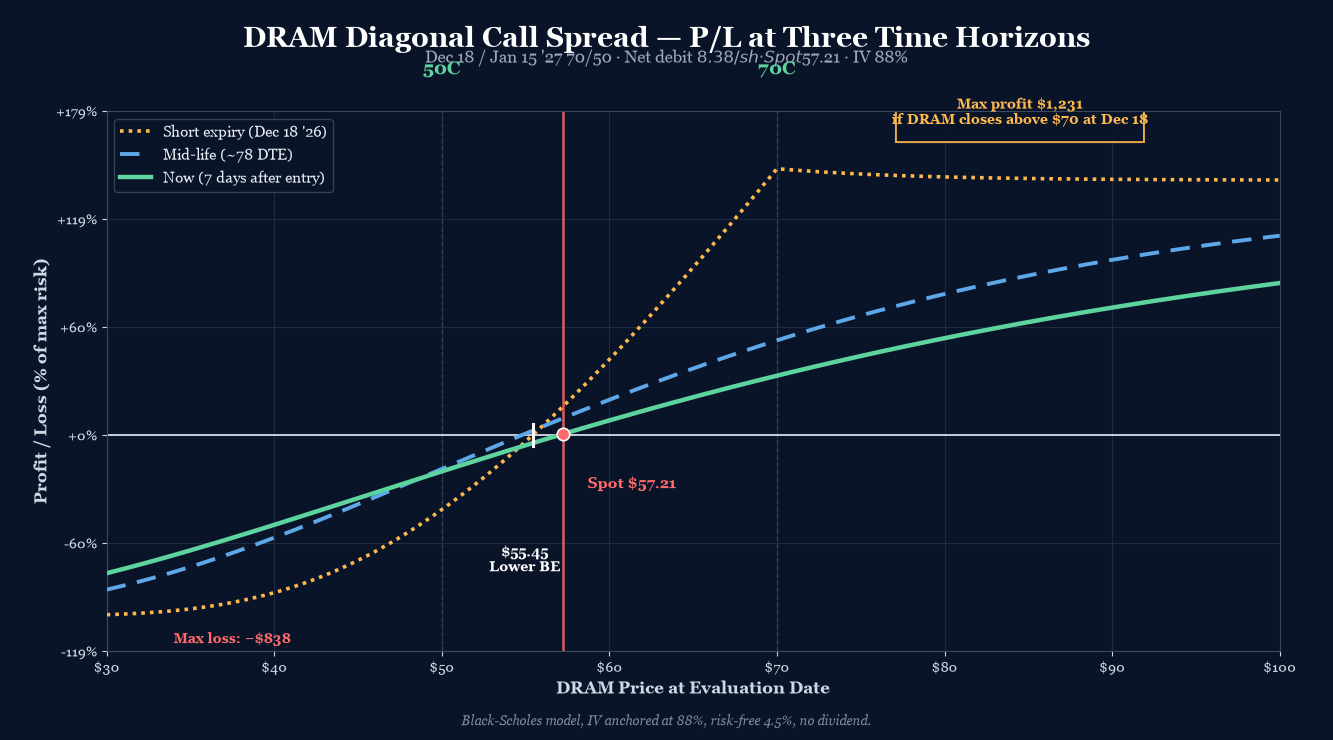
The chart shows the position's P/L as a function of DRAM's price at three evaluation dates: now (7 days after entry, ~149 DTE on short), an intermediate horizon at ~78 DTE on short (mid-September), and at short expiration on December 18, 2026 (intrinsic-only, long leg still has 28 DTE).
Read the chart:
- Spot $57.21 sits between the lower breakeven ($55.45) and the long strike ($50). The position is slightly positive because the long 50C retains meaningful time value at 184 DTE — the 28-DTE advantage over the short leg means front-month theta harvest is funding the back-month carry.
- Max profit plateau $1,231.44 opens at $70 and runs to infinity. Unlike a vertical spread, a diagonal has no upper cap — but the slope past $70 is shallower than a naked long call because the short 70C caps the upmove at $70 intrinsic minus the residual long time value at short expiration.
- Wings cut loss at the debit. If DRAM drops to $30 or rallies to $100, the position is bounded between −$837.50 and +$1,231 — defined risk with positive convexity past $70.
- The three curves diverge as DTE decays. The now-curve and the mid-curve sit roughly parallel above $50, with the mid-curve pulling away as the short 70C loses time premium faster than the long 50C. The expiration curve kinks sharply at $50 (long strike activates) and again at $70 (short strike inverts to liability) before flattening into the plateau.
- Lower breakeven $55.45 — DRAM needs to drop only ~3% to wipe out the debit. Tight breakeven is the diagonal's signature: the wide strike spread collapses the lower breakeven far below the long strike.
Verification
Leg fills were recorded in the source at entry: BTO 1× DRAM 50C Jan 15, 2027 at $17.425; STO 1× DRAM 70C Dec 18, 2026 at $9.05 — net debit $8.375. No independent chain verification (e.g., live yfinance mids) was disclosed in the source.
Sourcing and methodology
- Greeks — Black-Scholes at entry spot $57.21, 184 DTE on the long leg / 156 DTE on the short leg, IV surface anchored at 88%, risk-free rate 4.5%, no dividend yield; per-contract (×100 shares). Net delta +22.6, gamma −0.26, theta +$0.85/day, vega −$1.10 per 1% IV, rho +$3.73 per 1% rate — a long-delta, short-gamma, long-theta, short-vega profile, a textbook bullish-but-vol-cautious stance.
- Payoff chart — generated with OptionStrat (plain-text reference; the source page linked its interactive builder).
- Pre-entry move — DRAM corrected −28% from its June peak ($80 → $57.21), with the strategy premium declining from ~$1,236 to ~$847/contract over the last month.
Position Update Log
| Date | DRAM Price | Position Value | P&L | Notes |
|---|---|---|---|---|
| 2026-07-15 (entry) | $57.21 | $837.50 debit | — | Opened. IV 88%. Long 50C Jan '27 + short 70C Dec 18. |
Position just opened; theta bleed is minimal at 156/184 DTE. DRAM is at the lower-breakeven cushion zone, slightly above $55.45. No management action required at this stage. Watch for: DRAM breaking decisively above $68 (start taking partial profit on the short 70C) or below $48 (stop loss triggered). Status at publication: open.
Lessons recorded in the source
Expressing a memory-cycle bullish view with a diagonal rather than a naked long LEAP kept the net debit meaningfully lower ($837.50 vs ~$1,743 for a naked 50C LEAP) while preserving defined-risk characteristics; selling the front-month 70C generated immediate theta carry (+$0.85/day) and pushed the lower breakeven down to $55.45 — a −3% cushion from entry. Two things to watch: the net short vega (−$1.10/contract) — if IV collapses from 88% to 50%, the debit drifts roughly −$4 to −$5 against the theta harvest; and the diagonal's edge comes from the time-value differential, which works best when the short leg has 60–90 DTE left — early patience is required. For the playbook: the next iteration should explore rolling the short leg if DRAM spikes past $75 in months 1–2 (the "rolling diagonal" pattern — close the short 70C for $5+ profit, reopen at 75C or 80C to recapture theta).
Disclosure
The desk may hold the positions, options, or underlyings mentioned in a trade-log entry at the time of publication; positions are disclosed in the trade-log entry itself. Nothing on this site is investment advice.
Disclaimer. This content is published for informational and educational purposes only. Nothing here is investment advice. Trading options involves substantial risk of loss and is not appropriate for every investor. Past performance, including the journal entries on this site, does not guarantee future results. You are solely responsible for your trading decisions.